NOTE: This is Hampton’s PERSONAL opinion and interpretation of history and modern advancements. None of this is an official Block policy, position, or plan.
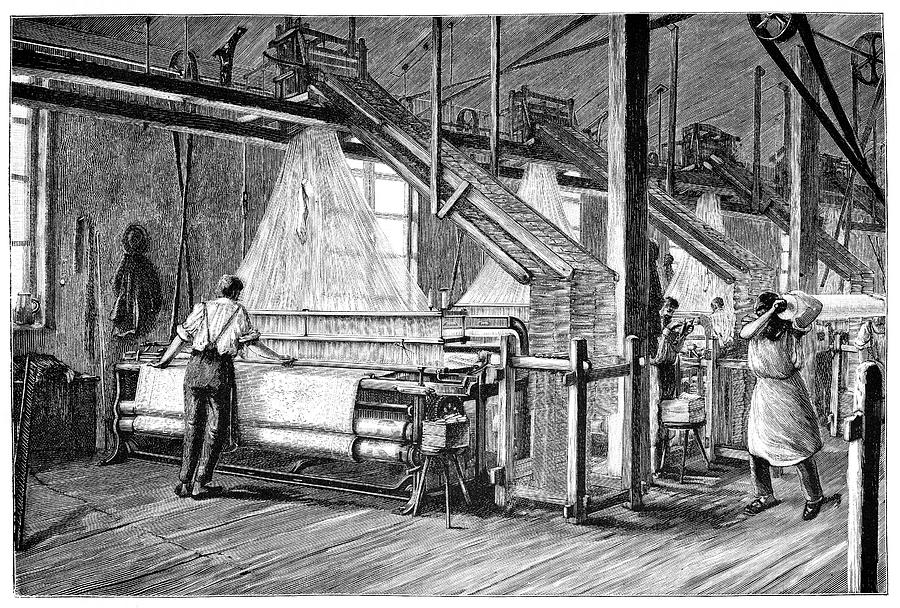
In 1801 in the French town of Lyon, Joseph-Marie Jacquard showed off his new weaving machine, the “Jacquard Loom”. This loom was basically an early version of a ‘computer’ in that you could feed punch cards into the loom and the loom would automatically follow the patterns coded into the cards.
The invention improved production rates from 2 inches a day to 2 feet of fabric a day.
That’s a 1,100% increase in productivity– and as a bonus, no human was needed to manually and carefully thread anymore!
Wait… if there was someone at every machine threading the loom and producing 2 inches a day- what happened to them? The answer is their job all but disappeared.
These were good jobs that were considered highly skilled. Just imagine having to count threads exactly right and carefully place them. In fact, the pay for these roles was originally 6 shillings a day, enough for a comfortable middle class life, but after the loom was rolled out- pay dropped 80% for those who still had jobs.
The role1 was highly specialized, highly technical, and well compensated for the time.
And just like that… over a period of 20 years the job and career entirely disappeared.
In fact, the job loss got so bad that people began to have multiple riots. That’s actually where we get the term Luddite, because some workers in the UK (which didn’t even HAVE the loom at the time) got so upset they rioted. And some of the riots that broke out are considered “émeute de la faim” - hunger riots2- where the main reason for the riot was actual starvation from job loss.
Does that mean that EVERYONE in the textile industry lost their jobs? No! In fact, partly due to this increase in productivity and complexity now possible- production surged and France eventually became a powerhouse of textile creation. This is part of why we associate France with high end fashion. These disruptions can be net positive- though painful and horrible.
Just a bit of Ping Pong3
The roles that succeeded were in the creative and even more technical fields. The people who thrived are the ones who figured out how to get it to be 4 feet of fabric a day instead of the new-standard of 2. The ones who started designing new outfits. The ones who figured out how to export to new markets.
—
If the similarities aren’t clear to you yet, then you better snap out of it.
Programming is no longer a job.
That’s right, we are those few who are caught right in the middle of a huge flux in our chosen industry. History has chosen us to be here for this moment- so buckle up. You better be eyes open to it.
For instance, on Friday, in a single day, I expanded my uuidv7 library from just being in Java/Kotlin to implementations in Ruby, Javascript, Swift, and Go. I didn’t open an IDE at all.
I didn’t type out the code- I didn’t do the programming.
However, doing this took considerable skill on my part (not to brag but…) by making sure I had a clearly defined set of library standards and design choices clearly laid out for the agents- I made sure I was happy with the choice of algorithms and that the compact format worked well. Of course, I built that in collaboration with an agent, but after some initial testing and iterating on the main library, I opened sessions with 5 different Amp Agent sessions. I used a local code review tool to give feedback on each of the agents' results, making sure that the software was high quality.
I was running a factory of programmers.
I was powering many looms with my experience in Software Engineering– and doing zero Programming.
And, I’m far from the most advanced at running this sort of work yet- and I know many of you reading this are far beyond me. But that’s not the point and you likely aren’t the audience.
The audience is people who think that their job is to get a relatively clean set of tickets and requirements handed to you and you need two weeks to complete that task.
What about my complex codebase!?!
I’ve been successfully using agents inside some of the most critical and complex backend systems at Square. Doing so requires careful work and can easily go awry if you let it. I use forms of RPI and break up the work into clear and agreed upon steps.
And if the agents get confused about something, I make changes to my prompting and/or update AGENTS.md or create a custom skill for some task that’s tricky.
If agents aren’t working well in your codebase, you need to figure out why that is instead of throwing your hands up.
And- today is the very worst these Agents will ever be. These models can only get better- so even if you see them struggling today, they are likely going to only improve.
Expectations in this industry have fundamentally changed.
We are experiencing the 2 inches of daily production to 2 feet of production shift that looms had. This is us. This is the difference from 2024 to 2026.
Waiting for Product to have requirements perfectly ready, or waiting for the next sprint, or even putting something into a backlog and getting to it later- that’s all done. Gone. Kaput.
We are now at the precipice of what could be a 1,100% increase in productivity and if you can’t think that fast or are not creative enough to do that- it’s gonna be a struggle.
Engineers, not construction workers.
In software engineering, we often call ourselves “engineers” and so let’s use the metaphor of Engineering vs Construction. If you design bridges as an engineer, you generally never weld anything to anything. However, you know all about welds and weld types and weight distribution and material shearing and wind loading.
You have construction workers, often thousands of them, that DO the thing that you have a vision for. Your 80 hours on a project means hundreds of thousands of hours of construction worker time.
Engineers still have careers. Programmers (construction workers) do not.
Why so mean?
Any perceived harshness does not come from any malice whatsoever. In fact, it’s the opposite. It comes from wanting everyone to have the best chance they have to get to the other side of this tsunami of change.
I want you to succeed!
And de’ Nile isn’t just a river in Egypt, ya know?
I’ve heard so many engineers say “Oh, I dabble but I just don’t think AI can do it well” are just in absolute denial at this point. Yes, AI can do a terrible job right now if you don’t wield it properly. The loom can make a mess of things if it’s improperly used. But, this is the worst these tools will ever be. They will only get better.
And it’s not just the tool usage, just the way you think and work has to change. I believe our processes and planning need massive rethinking going forward. I just don’t think 6 month plans and 2 week sprints are the right granularity anymore for the work we’re doing.
It’s all changing whether you like it or not. It’s already changed, we just haven’t adjusted- but I can tell you that it’s happened and the first step is acceptance.
-
Called a “Draw Boy”— but the name sounds silly so I skip it. ↩
-
Stereolab’s Ping Pong - Lyrics
It's alright 'cause the historical pattern has shown
How the economical cycle tends to revolve
In a round of decades, three stages stand out in a loop
A slump and war then peel back to square one and back for more
Bigger slump and bigger wars and a smaller recovery
Huger slump and greater wars and a shallower recovery ↩